
Why PU Foam Fails for Liquid CO2
20 July 2026
The -26°C Illusion: Why Polyurethane Foam is Secretly Sabotaging Your Liquid CO₂ System
If you walk through almost any industrial food freezing plant utilizing Liquid Carbon Dioxide (LCO2), you will likely hear a familiar piece of conventional wisdom: "Liquid nitrogen operates at -196°C, so it absolutely requires Vacuum Insulated Piping (VIP). But liquid CO2 at 18 bar is only -26°C. That’s barely colder than a commercial walk-in freezer! Standard Polyurethane (PU) foam is more than adequate. Upgrading to VIP is just expensive overkill."
It sounds completely logical on the surface. But thermodynamically, this assumption is an expensive trap. While LCO2 is technically "warmer" than liquid nitrogen, its underlying physics make it uniquely volatile and intensely sensitive to heat influx. Relying on PU foam insulation doesn't just lower efficiency—it triggers a destructive chain reaction of ice-bridging, vapor-locking, and massive financial loss. Here is why the "-26°C is not cryogenic" argument is a myth, and why upgrading to VIP is a baseline operational necessity.
1. The Thermodynamic Trap: The Volatility of LCO₂
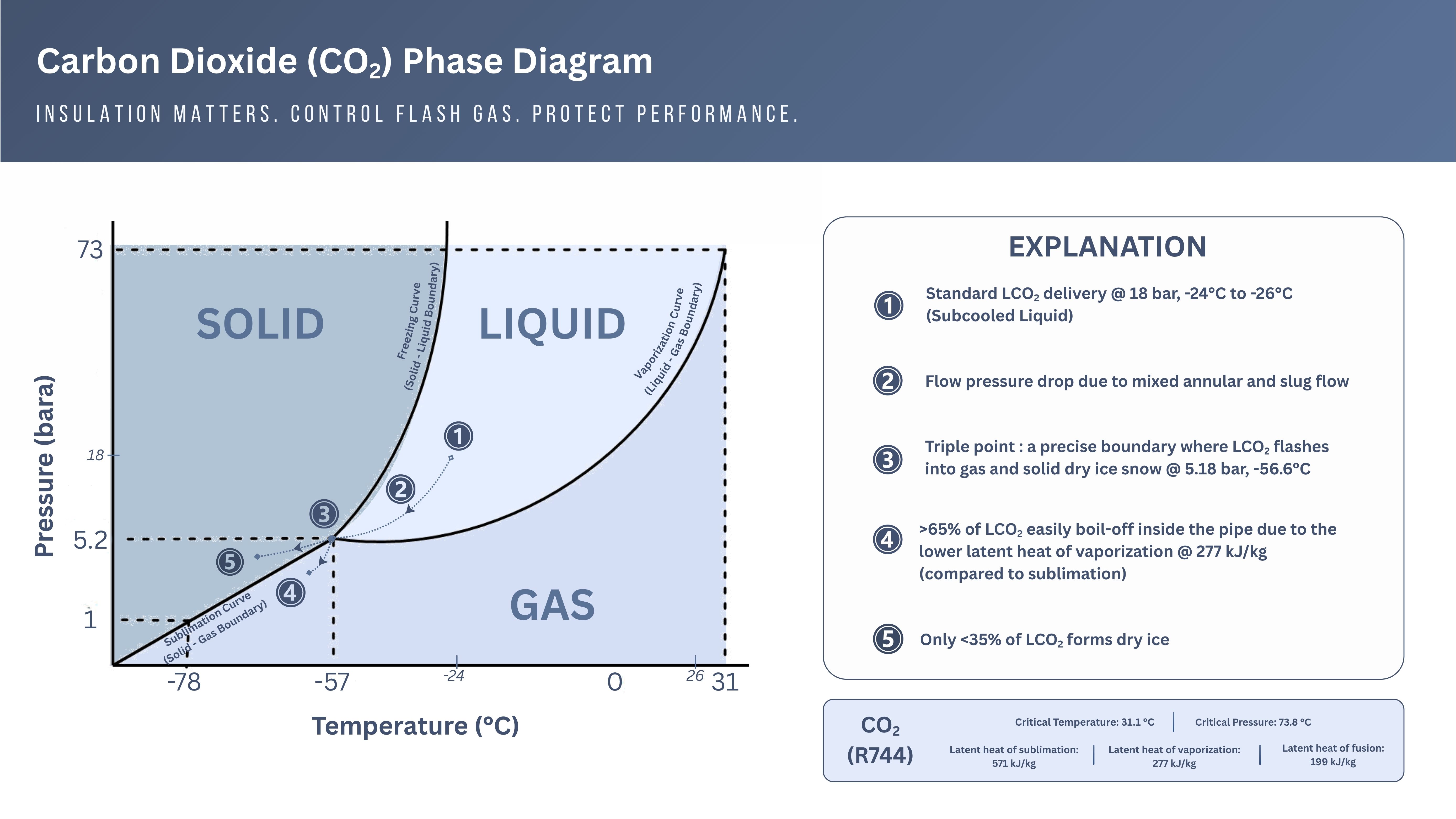
The reason liquid nitrogen demands intense insulation is its sheer temperature distance from ambient air. However, LCO2 presents a completely different challenge: it operates dangerously close to its own thermodynamic tipping point.
At a standard delivery pressure of 18 bar, LCO2 exists as a subcooled liquid at roughly -24°C to -26°C. But the triple point of carbon dioxide—the precise boundary where it can no longer exist as a liquid and instead flashes into gas and solid dry ice snow—is at 5.18 bar and -56.6°C. Because liquid carbon dioxide has a relatively low latent heat of vaporization (~280 kJ/kg), it takes very little heat energy to force the liquid to boil inside the pipe. Any heat passing through your insulation instantly creates flash gas.
2. The "Ice Bridge" Phenomenon: Why PU Foam Always Fails
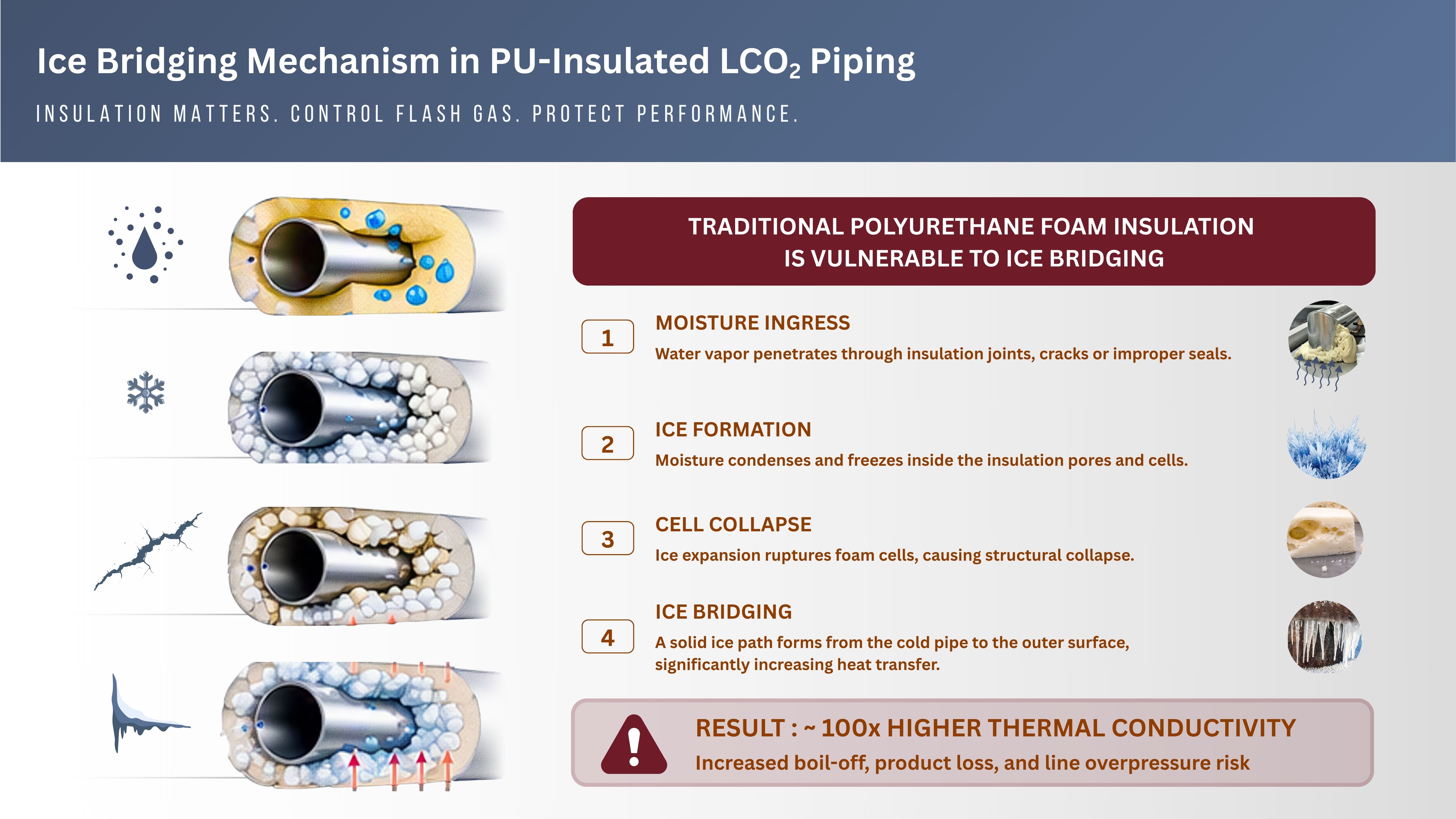
PU foam is a porous material. When cryogenic or sub-ambient liquids pass through a stainless steel pipe, the metal contracts. Over a 300-meter run, an LCO2 line will physically shrink by 26.4 cm. This microscopic shifting, combined with ambient humidity and outdoor UV exposure, inevitably creates structural stress fractures in the rigid PU foam jacket. Once a micro-crack forms, atmospheric moisture is drawn into the insulation body. The moment that moisture hits the cold pipe, it freezes.
VS
Waterlogged Solid Ice: k ≈ 2.2 W/m·K
This is where the system completely breaks down: Dry Polyurethane Foam has an excellent thermal conductivity of k ≈ 0.022 W/m·K. Solid Ice has a thermal conductivity of k ≈ 2.2 W/m·K. Ice conducts heat 100 times faster than dry foam. If your LCO2 pipe is sweating or covered in ice, your insulation has fundamentally failed. It is no longer an insulator; it is an active thermal bridge pouring ambient energy directly into your subcooled liquid.
3. The Scale Effect: < 30 Meters vs. > 30 Meters
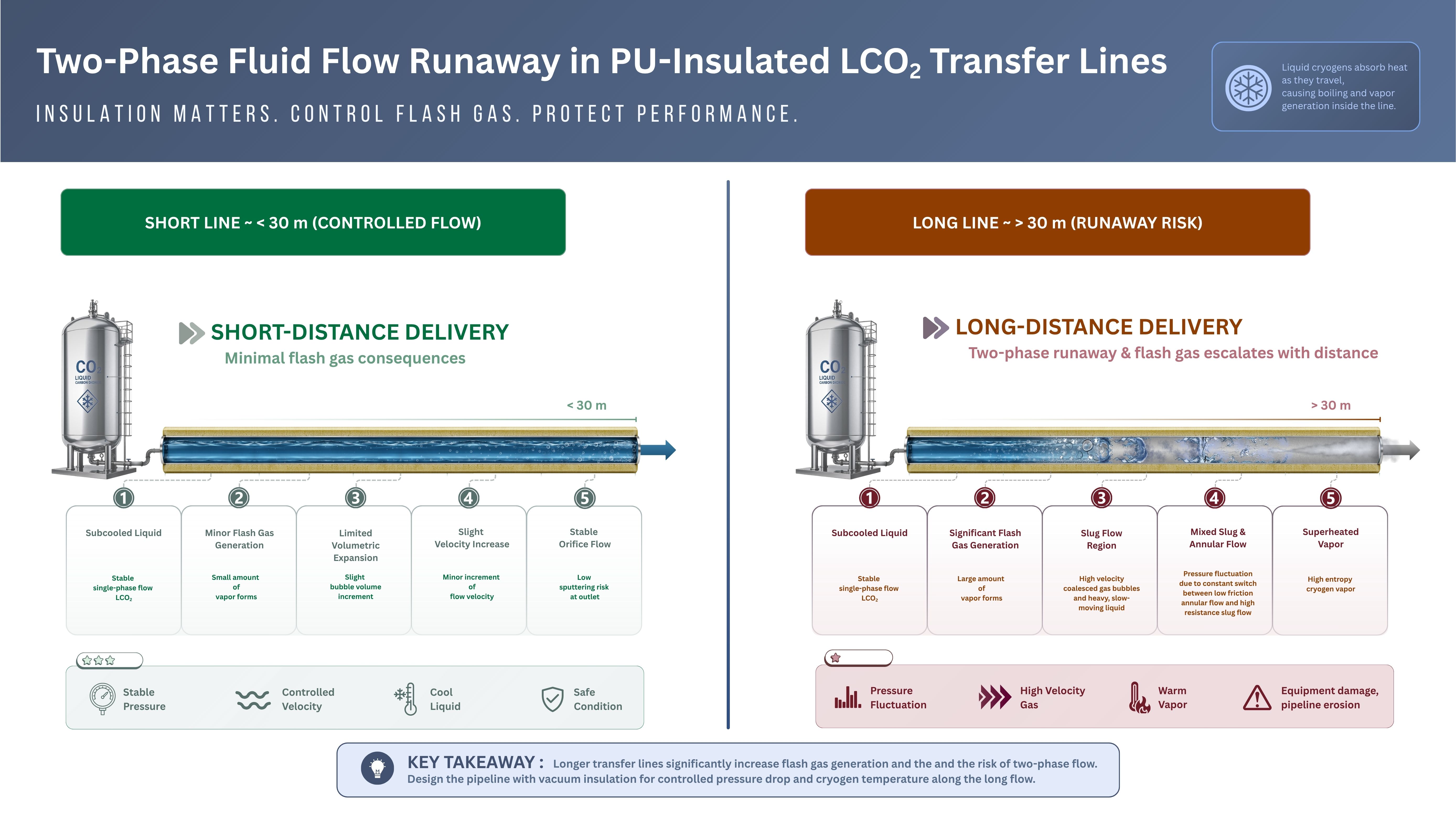
The industry misunderstanding is often kept alive by small-scale operations. If a plant only has a short 30- meter transfer line from the storage tank to a single freezing tunnel, the penalties of PU foam are often masked. In a 30-meter line, the liquid passes through the pipe so quickly that even though heat is leaking through the failed foam, the fluid reaches the nozzles before a catastrophic volume of flash gas can develop. The pressure drop is minimal, and the freezer appears to run smoothly. The plant owner assumes PU foam is "technically adequate."
However, in a 300-meter line, the pipeline becomes a massive thermal radiator. The cumulative heat influx across 300 meters creates a violent thermodynamic runaway. As heat leaks into a 300-meter line, a large percentage of the liquid vaporizes into gas pockets mid-transit. Because gas occupies 30 to 50 times more physical volume than liquid, the fluid velocity inside the 2-inch pipe accelerates rapidly. This velocity spike creates extreme internal friction, causing a catastrophic pressure drop. By the time the fluid nears the end of a 300-meter line, the internal pressure plunges toward the triple point threshold. Instead of a clean, single-phase liquid arriving at the food freezing tunnel, you get severe nozzle sputtering, vapor locking, uneven temperature control, and starved freezers.
4. The Hidden Costs: What PU Foam is Costing Your Plant
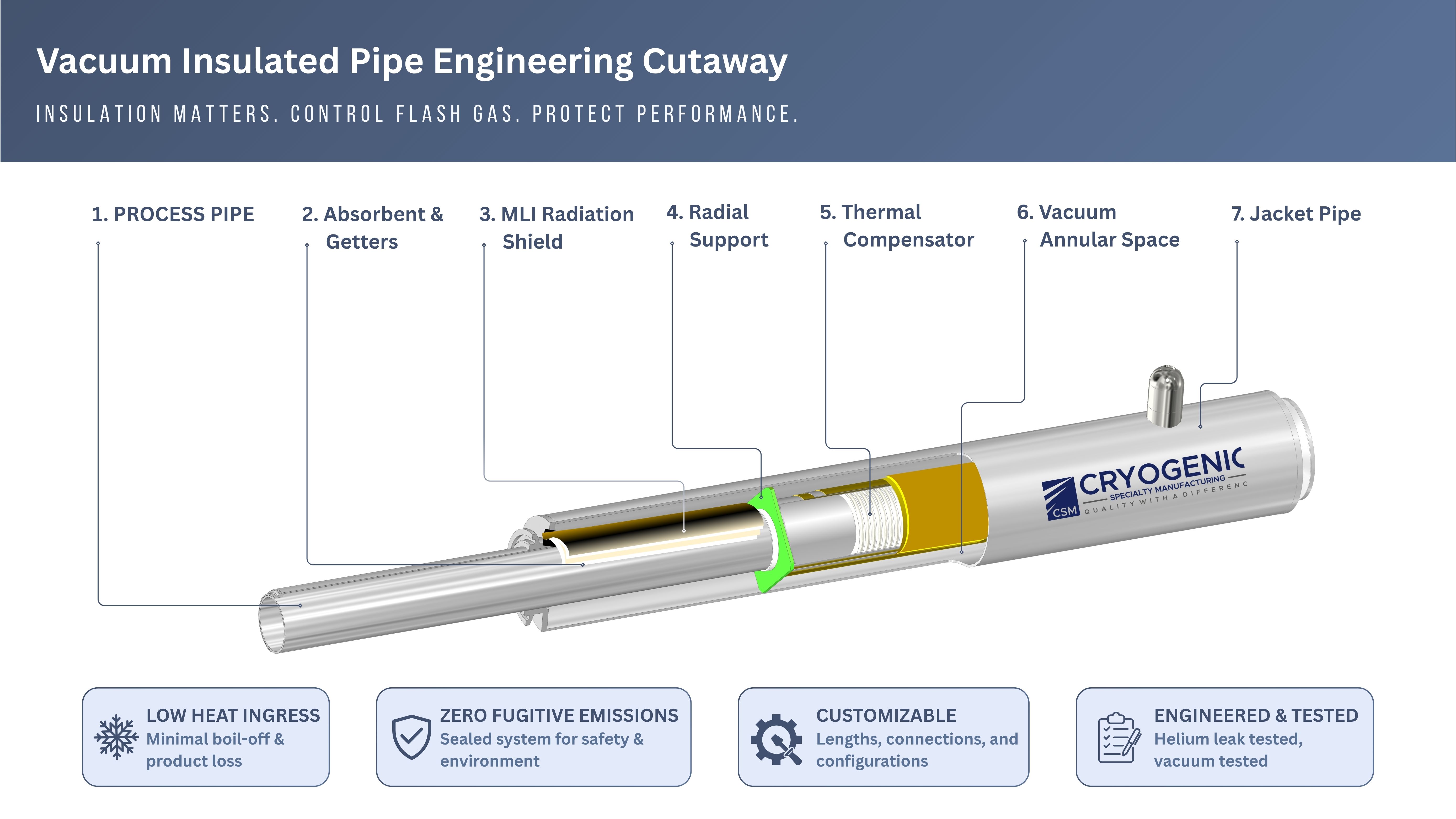
Choosing insulation based on upfront material cost alone ignores the massive utility bleed happening behind the scenes. When contrasting a failed PU foam network against an engineered VIP system (like the CSM Model R20P), the financial return becomes clear across four operational pillars (evaluated on a schedule of 16 hours/day execution, 8 hours/day standby, 300 days/year, with bulk LCO2 valued at $0.15/ kg):
Standby Venting Losses
$113,728 Annual LossDuring overnight shutdowns, heat entering iced PU foam insulation boils stagnant liquid inside the transfer line. Safety valves automatically vent gas to prevent over-pressurization, resulting in significant annual product loss.
Operational Flash Gas Elimination
$172,800 Annual RecoveryFlash gas reduces snow-generation efficiency inside the freezing tunnel. For a 3,000 kg/hr freezing operation, eliminating this vapor waste can recover approximately 8% of total CO₂ consumption.
Morning Start-Up Purges
$29,700 Annual SavingsA 300-meter, 2-inch transfer line contains approximately 660 kg of liquid CO₂. Under degraded insulation conditions, much of this inventory vaporizes overnight and must be purged every morning before production begins.
Constant Maintenance Cycles
$5,000 Annual CostWaterlogged PU insulation requires recurring removal, inspection, repair, re-lagging, and corrosion-under-insulation mitigation throughout its service life.
Conclusion: VIP is the Real Cost-Saver
While a capital investment of $250,000 to $300,000 for an engineered CSM Model R20P vacuum insulated system might seem higher upfront compared to standard foam, it stops a massive utility drain of $321,228 every single year. With a complete capital payback achieved in just 9 to 11 months and a maintenance-free lifecycle exceeding 20 years, transitioning from PU foam to VIP isn't an expensive luxury for liquid carbon dioxide—it is a high-yielding necessity.
| Performance Metric | Traditional PU Foam | CSM VIP (R20P) |
|---|---|---|
| Heat Influx | 24,750 W | 178.6 W |
| Fluid Phase Delivered | Liquid + Gas | Single Phase Liquid |
| Nozzle Characteristics | Sputtering | Consistent Spray |
| Annual Product Loss | 2,108,184 kg/year | 0 kg/year |
| Financial Impact | $321,228/year Utility Bleed | 9-11 Month Payback |
Executive Summary
PU foam insulation may appear economical initially, but for long-distance LCO₂ transfer systems it becomes a significant source of heat ingress, product loss, venting losses, maintenance costs, and process instability. Vacuum Insulated Piping transforms the system from a continuous operational liability into a highly efficient long-term asset.
Frequently Asked Questions About Liquid CO₂ Piping Insulation
Answers to the most common questions about Liquid CO₂ transfer systems, insulation performance, flash gas generation, and Vacuum Insulated Piping technology.
Is -26°C considered a cryogenic temperature?
While liquid CO₂ at approximately -26°C is warmer than liquid nitrogen, it still behaves like a cryogenic process fluid in many industrial applications. The key issue is not temperature alone, but the fluid’s sensitivity to heat ingress and pressure changes.
Why does liquid CO₂ require high-performance insulation?
Even small amounts of heat entering the transfer line can create flash gas, pressure instability, and reduced production efficiency. Effective insulation helps maintain stable single-phase liquid delivery.
Why does polyurethane foam insulation fail over time?
Repeated thermal cycling, contraction, moisture intrusion, UV exposure, and weather conditions can cause cracks within the insulation. Once moisture enters, thermal performance deteriorates rapidly.
What is the Ice Bridge phenomenon?
Ice Bridge formation occurs when moisture penetrates damaged insulation and freezes around the cold process pipe. Ice conducts heat far more efficiently than dry insulation, creating a direct thermal path into the system.
What are the signs of failed LCO₂ insulation?
Common symptoms include pipeline icing, sweating, excessive venting, unstable nozzle spray patterns, unexpected CO₂ consumption increases, and inconsistent freezer performance.
Does pipeline length affect liquid CO₂ efficiency?
Yes. Long-distance pipelines accumulate significantly more heat gain than short runs. This can increase flash gas formation, pressure drops, and operational instability if insulation performance is inadequate.
What is Vacuum Insulated Piping (VIP)?
Vacuum Insulated Piping uses a dual-wall design separated by a high-vacuum space that minimizes heat transfer. This allows liquid CO₂ to remain in a stable subcooled state over long distances.
What advantages does VIP offer compared to PU foam?
VIP significantly reduces heat ingress, minimizes flash gas generation, eliminates ice formation, lowers maintenance requirements, and improves process reliability.
How quickly can a Vacuum Insulated Piping system pay for itself?
In many long-distance liquid CO₂ applications, reduced venting losses, lower maintenance costs, and improved product utilization can result in payback periods measured in months rather than years.
Can VIP improve food freezing performance?
Yes. By maintaining stable liquid delivery, VJP helps produce consistent snow generation, better temperature control, improved product quality, and lower overall CO₂ consumption.