
Conditioning Equipment in Ensuring Optimal Liquid Cryogen Delivery
18 April 2026
-
The Purpose of Cryogenic Conditioning Equipment
When liquid cryogens such as nitrogen travel through transfer piping, they inevitably absorb heat from the environment. This heat infiltration causes the liquid's physical properties and behavior to change—most notably through vapor formation, which leads to two-phase flow. The result is pressure fluctuations, inconsistent liquid delivery, and reduced cooling efficiency at the point of use.
Cryogenic conditioning equipment addresses these challenges by ensuring single-phase, low-pressure liquid cryogen delivery. Each component serves a specific function in maintaining liquid quality throughout the transfer process.
-
Individual Equipment: Working Principles
CryoVent (Electronic vs. Mechanical)
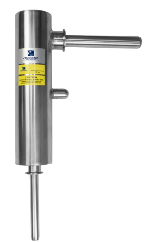
The CryoVent functions as a "keep-full device", removing vapor that accumulates when liquid in the pipeline is not in active use. Static heat leaks continuously evaporate liquid into vapor; the CryoVent exhausts this vapor to atmosphere, ensuring the pipeline remains completely liquid-filled. It is typically installed at the highest points of the system, such as main-risers and header ends.
The electronic 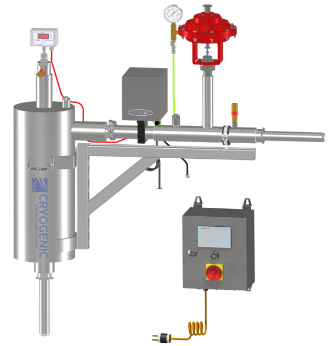 version features a vacuum-jacketed venting valve and PID control loop, offering more precise control compared to mechanical float-type actuation. With variable venting control, the electronic version can respond to the transient vapor load due to cryogenic liquid demand dynamics, unlike the fixed-orifice venting characteristic of the mechanical version.
Phase Separator (Atmospheric vs. Pressure Adjustable) 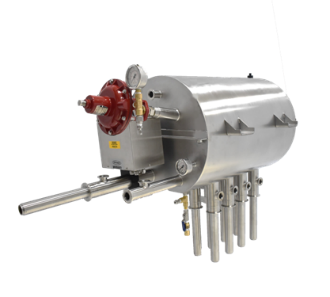
The phase separator removes vapor from a two-phase liquid stream while stepping down incoming liquid pressure. It operates on principles of liquid decompression and volume expansion, with storage capacities ranging from 22 to 100 liters. Electronically modulated, electro-pneumatic vacuum-jacketed valves provide precise control over liquid level and pressure.
The atmospheric version delivers subcooled liquid at 1 atmosphere, making it critical for sensitive applications such as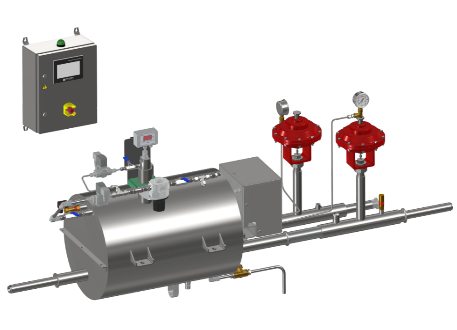 molecular beam epitaxy (MBE) or SEM/EDX analysis. The pressure-adjustable version allows for flexible pressure control based on application requirements.
Degasser 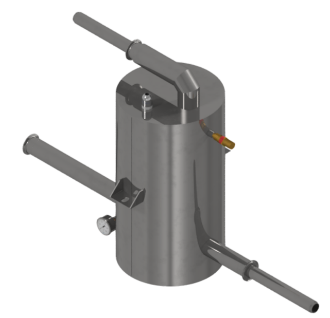
Unlike the CryoVent, which addresses static conditions, the degasser removes vapor during both static and flow conditions. As liquid velocity reduces due to sudden volume expansion, vapor separates via liquid decompression. Degassers are typically placed mid-pipeline or at the point of use and are available in both mechanical and electronic versions.
Subcooler 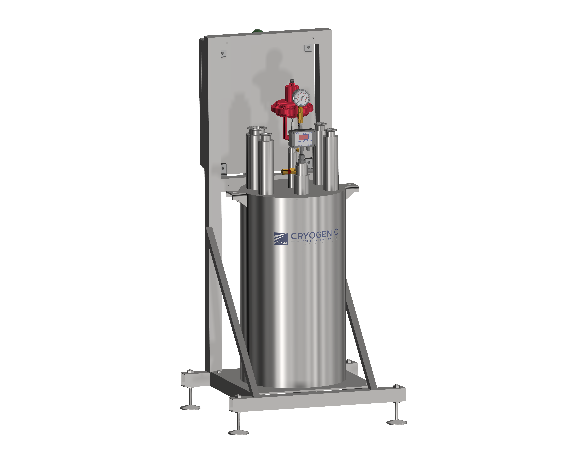
The subcooler reduces liquid cryogen temperature below its saturation point at a given pressure. By lowering the liquid's entropy, it significantly increases cooling capacity. This makes the subcooler essential for processes requiring maximum cooling power. Additionally, subcoolers are valuable for long-distance transfer of cryogenic liquid within VJ piping, reducing the need for excessive vapor vent devices along the pipeline.
Apart from heat infiltration, a critical yet often overlooked phenomenon in cryogenic transfer systems is viscous and friction heating. This refers to the internal generation of thermal energy caused by friction between moving fluid layers (internal shear stresses) and pipe surface. In systems where liquid nitrogen flows at velocities exceeding 0.5 m/s—typically due to undersized piping or excessive use of corrugated flexible hose—the cryogenic fluid absorbs significant energy from this internal friction. This energy absorption leads to unwanted vaporization (boiling) and a corresponding reduction in cooling capacity at the point of use.
While viscous heating is often negligible in low-viscosity fluids, it becomes critically important in cryogenics. Liquid nitrogen has a very low latent heat of vaporization (approximately 199 kJ/kg). Consequently, even slight temperature increases from viscous dissipation can cause subcooled liquid to cross its saturation point, resulting in gaseous pockets and disruptive two-phase flow.
The subcooler serves as a powerful and easily deployable solution to this challenge. When integrated into a transfer system, it effectively brings viscous-heated, warmed liquid nitrogen back to its fully subcooled state, restoring its cooling capacity and ensuring reliable, single-phase delivery to the application.
-
The Physics: Why Conditioning Matters
During liquid cryogen transfer, heat infiltration causes several detrimental effects:
-
Vapor formation leads to two-phase flow, which creates pressure drop fluctuations.
-
Inconsistent liquid delivery results in warmer liquid reaching the use point.
-
Cooling capacity is reduced due to the latent heat of vaporization being consumed by vapor generation rather than useful cooling.
Proper conditioning directly counters these effects by removing vapor, controlling pressure, and maintaining liquid quality throughout the system.
-
Selection Guide
When selecting conditioning equipment, the specific requirements of your application should guide your choices.
For Entropy and Temperature Reduction
A subcooler is the appropriate choice when maximum cooling capacity is required. It is particularly essential for high-heat-load applications where maintaining liquid temperature below saturation point is critical. Example applications include semiconductor device hot and cold cycle testing, lyophilization of biopharmaceutical products, and food freezing (IQF).
For Vapor Reduction
Vapor reduction requires a combination approach. The degasser should be selected for vapor removal during flow conditions, while the CryoVent addresses static conditions when liquid is not moving through the pipeline. Proper sizing requires estimating static heat leaks and system head loss to determine the correct number and capacity of units needed.
For Pressure Control
A phase separator allows cryogenic liquid pressure control at the point of use instead of at the bulk storage tank. This gives the user a higher level of autonomy and flexibility in fulfilling their process pressure needs without over-reliance on the liquid gas supplier's technical support—which can be difficult to obtain at times—or without being affected by variations in liquid supply saturation conditions or bulk tank pressure and level fluctuations.
A pressure-adjustable phase separator is particularly useful in multi-story production facilities where it is impractical to set a single bulk tank pressure to accommodate varying head pressure losses due to floor height differences.
-
Conclusion
CSM's comprehensive range of cryogenic conditioning equipment ensures reliable, high-quality liquid nitrogen delivery for even the most demanding applications. Proper equipment selection—based on thorough understanding of system dynamics and application requirements—optimizes both performance and operational efficiency. With cryogenic engineering expertise dating back to 1997, CSM stands ready to support customers in designing and implementing optimal conditioning solutions.
Back